
Table of Contents
Flavour and its impact on our daily lives, psychology, and decision-making are often overlooked factors. In everyday life, we spend more time thinking about satisfying our physiological needs for food and drink and less time understanding how the flavour works and its effect on our emotional state. Understanding why we like what we like will help us better manage our food choices or drinks.
In the Food & Beverage industry, particularly in restaurants and bars, if chefs and bartenders focus only on the actual taste of the dish or drink, they are not fully exploring the potential of a whole flavour experience by the intended clientele.
Granted, the taste of a drink or dish is essential, but it is only half the story of achieving and offering a complete flavour experience.
The flavour is a multisensory sensation, and its perception process starts long before we even try anything. It begins with subconscious feedback from our peripheral senses; it creates motivation, “I want to have it,” making sense of it on a conscious level, and taking action (ordering the product).

Taste and smell are the last parts of forming a flavour opinion. If any previous elements are not up to our guests’ expectations, the customer’s dining experience may not be as we wanted it to be.
Some examples of factors and questions influencing flavour perception can be:
- Visual feedback of the surroundings we are in. Do we like the palace we are in?
- Presentation: Do we like the way our drink or food looks like? How many times do we get an order based on the “I want the same as the other table is having”
- Presentation: Do we like the way our drink or food looks like? How many times do we get an order based on the “I want the same as the other table is having”
- Do we hear anything that may not meet our expectations of a pleasurable ambiance?
- Do we smell any weird odours?
- The cleanliness of the establishment and the staff working there.
- Professionalism – the expected level of professionalism and privacy from the serving personnel based on the establishment’s projected image.
If some of the above criteria don’t meet our guests’ expectations, it doesn’t matter how good the drink tastes; the customers will not fully appreciate the intended flavour, and the resulting feedback will not be what we were hoping for.
To allow the intended perceived flavour to be enjoyed entirely, we should shift our focus from the physical properties of the smell and taste and include its emotional part, as they are integral to forming a positive flavour image in our brain.
That’s where the ultimate decision on whether we like something occurs; not factoring in all the variables that lead to that decision will most likely result in unsatisfied guests.
To understand how a flavour works, let’s define what it is and how we decide what tastes or may not.
The beauty of a flavor is that it can trigger olfactory (smell), gustatory (taste) and trigeminal (nervous) sensations…it enables us to enjoy unique and pleasurable flavors and trigger emotions, and multi-sensory experiences” 1
— according to Catherine Vermeulen, Flavor Expert at Puratos
Flavor Elements
The flavour consists of:
- Smell
- Orthonasal olfaction
- Retronasal olfaction
- Taste
- Touch (Mouthfeel)
- Vision
- Hearing
- Emotional factors
- Memories
- Cultural background
- Expectations
- Emotional state
Let’s define these senses and their role in forming a flavour opinion.
By themselves, food ingredients don’t have flavour. There are raw materials with their molecular composition from which the brain creates flavour.2
For the brain to create a flavour image, it needs information input that utilizes the smell, taste, and touch sensors to relay the detected molecules or sensations in the food or drinks to the brain’s sensory processing center.
Smell Sense – Orthonasal olfaction
The sense of smell, known as olfaction, is part of the olfactory system. It is a dual system of detecting odour molecules. The first pathway is through the nose (orthonasal perceptions), and the other is through the mouth (retronasal perceptions).
The aroma is responsible for nearly 80 percent of the initial flavour perception.
Aroma’s pathway to the sensory processing center begins with detecting the molecules in the air and sending a signal through the olfactory nerves straight to the brain sensory center (the olfactory bulb), where the contextual smell image is created. From there, the odour messages go to several brain structures that make up the “olfactory cortex.

The olfactory cortex (the “older primitive” subconscious area of the brain’s emotional and memory center and place where the content addressable memory is formed)3 send the smell input directly to the highest level of the human brain – the orbitofrontal cortex (the newer center for human’s cognitive functions). By bypassing the thalamus (the relay sense center, to which other senses, taste, vision, and hearing are connected) and connecting directly to the highest level of decision-making, it shows that the brain treats smell as a critical part of evaluating and preserving our body from potentially harmful substances.
The olfactory bulb (sensory center) connects to the olfactory cortex, the emotion center (amygdala), and the memory relay center (hippocampus). These last two areas are essential for emotion and memory formation, explaining why smell can trigger powerful emotions and memories before a person can identify the odour.

It is truly remarkable when a specific smell suddenly invokes long-forgotten memories. It feels like the world has stopped; for a brief moment, it is just you and a vivid memory image. All this processing happens subconsciously in the olfactory cortex, which evolved before the cortical regions that give us consciousness.
Olfactory Fatigue – Nose blindness
The olfactory sensors are highly adaptable to new aromas, which means after each subsequent sniff of an odour, the effect of this smell diminishes.
Eventually, that may lead to a temporary inability to distinguish a particular odour after prolonged exposure. For example, when entering a restaurant, we often perceive food’s odour as very strong. Still, after time, the awareness of the odour typically fades to the point where the smell is not perceptible or much weaker.4
One way to “reboot” our ability to smell is to use coffee beans as “nasal palate cleansers,” as per fragrance sellers.
College students repeatedly smelled three fragrances, rating odours to test this idea. After completing nine trials, participants sniffed coffee beans, lemon slices, or plain air. Participants then indicated which of the presented fragrances had not been previously smelled; coffee beans did not yield better performance than lemon slices or air. 5
Nevertheless, it is one more reason to buy coffee.
This condition is not to be confused with Anosmia, the permanent loss of the sense of smell and is different from olfactory fatigue.
Smell training
Research conducted at the University of Dresden’s Smell and Taste Clinic in Germany found that people can enhance their olfactory bulbs with training. The researchers added that people with an average sense of smell could increase the size of their olfactory bulbs by trying out four aromas twice a day for about 30 seconds each.
One can try by simply choosing four smells you are fond of: fresh coffee, bananas, soap or shampoo, and cheese. Then, each day, take two minutes to go through and smell each one individually to stimulate the receptors inside your nose. Millions of people’s smell sensations have been affected by COVID-19, and hopefully, learning how to smell again will help them regain this ability. 6
Retronasal Smell (Olfaction)
Retronasal olfaction is the perception of odours from the oral cavity during eating and drinking. Air is taken from the mouth and circulated to your nasal cavity.
The recognition of that contribution to smell has been known since 1886, as shown in a published essay by an American philosopher, Henry T. Finck, who referred to it as the “second way of smelling.” Over the years, the emphasis on categorizing the odour mainly focused on the orthonasal pathways. It was not until 1982 when Paul Rezin, a psychologist at the University of Pennsylvania, wrote an article where he recognized that smell is a dual sensor system comprised of breathing in (orthonasal) and breading out (retronasal) senses.
The retronasal smell differs from the orthonasal smell and can probably be considered a separate type of smell.
- It arises from the inside of the mouth.
- It is mixed with other senses (touch and taste).
- It is an active smell compared to other senses (othonasal, vision, and hearing). For the scent to be released, it needs an action (chewing, tongue movement)7
Retronasal Pathway
The retronasal path to smell begins with putting food or drink in the mouth, where the food is masticated (chewed) and broken into smaller pieces. The taste buds sample the food, and when the chewer exhales, the air is forced from the lungs back into the mouth, where it absorbs the released odours; because the mouth is closed, the air is forced up the nasal chamber to the nasal sensory neurons.
It is hard to recognize the retronasal smell as it fuses closely with taste and touch and is often referred to as taste. Usually, we classify something we eat as fruity or tasting like vanilla, which is impossible as there is no such taste; in fact, we use an odour to describe the taste.

Taste – Gustatory system
The primary purpose of taste is to protect us from harmful food and drinks, and it has evolved as a vital survival mechanism in mammals. Think of it as a gatekeeper; sweet might be good, but bitter or sour may signal spoiled food.
While drinking or eating, we constantly assess our products’ quality and personal satisfaction. The usual outcome of this process sounds like “It tastes like…”. The word taste has become an everyday expression/substitute for flavour.
The gustatory system is partially responsible for the perception of flavour. It is a nutrient-sensing system responsible for detecting different tastes, identifying toxins, maintaining nutrition, and regulating appetite and immune responses. 8.
There is a widespread belief that the tongue is the primary organ responsible for taste. It contains taste receptors that identify non-volatile chemicals in foods and beverages. It allows us to recognize their taste qualities in the mouth through a chemical reaction with taste receptor cells located on taste buds in the oral cavity, mainly on the tongue.
That’s true, but all the tongue does is detect chemical compounds and let the brain decide on the sensation it experiences.
In 2015, at Columbia University Medical Center, researchers conducted an exciting experiment proving that manipulating a group of molecules in mice’s brains could change how something tasted and turn different tastes on and off. This experiment also demonstrates that we are born with a sense of taste, as taste decisions are processed in the brain and not dependent on learning experiences.
Another proof that the taste is hardwired and we were born with it is an experiment done in 1974 by Jacob Steiner, an Israeli physiologist, on newborns one to two days old. Steiner’s research showed that humans can distinguish between various tastes. Visual expressions of satisfaction were observed when the babies were given a few drops of sweet stimuli. When the newborns were given bitter solutions, their facial expressions showed rejection and dislike. More on that topic: Taste of the newborn, p.77.
With this experiment, Professor Steiner and his team proved that we are born with taste abilities, and our emotions have been hardwired in our brains since birth, or probably even before that.
Types of taste and mouthfeel sensations
Each taste and sensation detects different nutritional components in food or beverages.
- sweet—reflecting the presence of carbohydrates/sugars
- sour—acidity
- salty—sodium and minerals content
- bitter—potential toxins
- umami/savoury – glutamates and other amino acids in seaweed, meat broths, and fermented products indicate protein.
- fat – more mouthfeel than flavour
- Astringency is similar to fat in that it has more feelings than taste.
- Salty and sour tastes are detected through ion channels.
- G protein-coupled receptors detect sweet, bitter, and umami sensations.
- Proteins called T1R1, T1R2, and T1R3 detect sweet and umami molecules.
- T2Rs protein detects bitterness.
Trigeminal sensations
They are hot, cold, spicy, tingling and electric sensations that could be used to enhance consumers’ enjoyment of foods and drinks,
according to Michael Nestrud, a sensory science Ph.D. candidate at Cornell.9.
These perception qualities are not officially recognized yet as taste, but there is considerable evidence of their taste sensations.
- Fat – a fatty acid transporter CD36 is found in the oral cavity on human taste buds, and decreased sensitivity to fat taste is also associated with increased fat consumption.
- The fat sensation was classified as a taste as early as 330 BC by Aristotle and later in a 1531 AD text on physiology by Jean François Fernel. More recently, fat has been associated with texture, flavour release, and thermal properties in foods, but not with the sense of taste*.
- Astringency – tannins in tea or red wine can cause this sensation, usually as roughness on the tongue. Imagine forgetting a tea bag in tea for a long time and then having a sip.
The trigeminal nerve is responsible for feeling in the mount and face, and it detects pain, touch, and temperature but not taste. The trigeminal sensory information is transmitted via the trigeminal nerve to the primary taste cortex and other areas responsible for olfactory and taste sensations. This leads to increased flavour perception of food and drinks. Other trigeminal sensations include:
- Compounds like capsaicin (chilli) trigger the spiciness.
- The cooling effect is produced by alcohol, menthol in mint, and peppercorns.

Another critical factor in the taste sensation is the presence of saliva.
Saliva is a liquid produced by the salivary glands at a rate of about 2ml every 15-20 min. Lack of it or insufficient saliva causes dry mouth, difficulties swallowing and chewing (mastication), and difficulty detecting the sapid molecules.
When food or other substances enter the mouth, molecules interact with saliva and are bound to taste receptors in the oral cavity and other locations. The molecules that give a sensation of taste are considered “sapid.”
Taste perception results from an interaction between sapid molecules and taste receptors on the taste buds*. The gustatory system detects these molecules and provides crucial information about the ingested food.
*The taste buds have a limited life span but can regenerate every 5 to 20 days. Imagine living without taste buds.

Taste signal Map
Where do all the taste buds generated signals go, and how do we make sense of it?
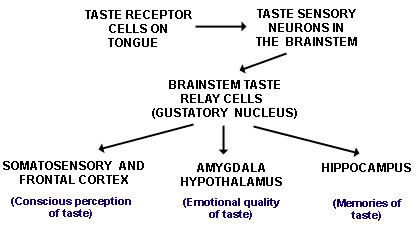
Once the ion channels protein receptors are activated, an electrical signal is sent directly to the brain’s primary sensory neuron terminal. Once the signal is received, it is sent through relay neurons to the “aah” and “wow” centers.
Someone reading this might say, “What’s he talking about? There are no such centers, ” which is true. There are no such areas in the brain, but there are systems that cause that reaction.
- The “aah” is the limbic system. It includes the hippocampus, hypothalamus, and amygdala, all connected to the emotional state and memory function. The limbic system is responsible for our feelings and the memories attached to them.
- The “wow” is the frontal cerebral cortex responsible for conscious decisions and thought processes.
Supertasters, are you one of them?
Different types of tasters are based on their sensitivity to the various compounds.
At Yale University in the 1990s, psychologist Linda Bartoshuk pioneered a study of genetic variations in taste perception. She created the term “supertaster” to describe the 25 percent of people intensely sensitive to bitter flavours. The other 50 percent were regular tasters, and the remaining 25 percent were non-tasters.
What differentiates them is the number of taste buds on the tongue. Supertasters have more taste and more; on the other hand, non-tasters have fewer taste buds and are less sensitive to different substances.
Professor Bartoshuk used a recently developed dyeing process to count the taste buds from all three taster categories on the tips of volunteers’ tongues. The results of the test were astonishing. The shape of the supertasters’ taste buds had a different form than the rest of the two groups, and the difference in the number of taste buds was staggering. They found that young non-tasters had 11 taste buds per square centimetre, and on the other end, a supertaster of the same age had 1,100 taste buds per square centimetre.
Do we choose what taster we are? Not really. It’s hereditary, just like the colour of our eyes or height.
The main difference between these three groups of tasters is their ability to taste and their sensitivity to certain substances, which determine the type of food or drink they like to a certain extent.
Sensitivity based on taste group
- Supertasters
- They have heightened taste sensations that make them more sensitive to all flavours.
- Generally, they don’t like alcohol; for them, alcohol tastes bitter, and they find the bitter taste in fruit and vegetables (broccoli, cabbage, kale) overpowering. Many kids are supertasters.
- Increased perception of acidity and irritants – many don’t like coffee or cigarettes.
- They don’t like fat or lots of sugar (they prefer not-so-rich desserts)
- They tend to eat more sodium-rich food, as salt balances the bitterness.
- Many chefs are supertasters.
- Normal tasters
- Alcohol tastes slightly sweet or mildly bitter
- They have an average sense of taste
- Non-tasters
- Enjoy spicy foods
- Consuming the most alcohol compared to other groups, they perceived the alcohol taste as sweet.
- They have less taste sensation and tend to be overweight
What taster am I?
A PROP test can be done to determine the type of taster one is. It is a piece of special paper that can taste bland, bitter, or even vile, depending on how sensitive one’s taste buds are to this chemical.
Prop stands for N-Propylthiouracil (PROP) taste paper for testing a genetically controlled ability to taste this substance.
How do we do the test?
You will need PROP paper strips; I bought mine from Amazon. Place the whole paper on your tongue, towards the back of your tongue, let it sit on your tongue, close your mouth, and move your tongue. Ask the person if they experience a bitter taste or not.
- High levels of bitterness indicate a supertaster.
- Moderate bitterness indicates regular taster.
- No taste, most likely non-taster status
Another way of figuring out what kind of taster you are is by using blue dye. How-to here.
On the professional side, a bartender or chef might encounter a few potential issues we should be aware of, which will allow us to adjust recipes.
- Supertasters might create a bland dish or drink with little flavour, using fewer spices.
- Non-tasters’ prepared dishes tend to have an overpowering flavour due to non-tasters lower sensitivity to taste and overcompensating by adding more spices, as they probably should.
Mouthfeel
The “feel” of a food or beverage, produced by mechanical stimulation and moderated by the sense of pressure, traction, and touch, is an essential but often overlooked flavour aspect.
The touch system tells us that a substance (food or drink) is in our mouth and triggers the taste (the gatekeeper) to inspect that substance. The results are sent to the brain, where a decision is made on whether the substance is safe to eat.

Once we get the go-ahead that the food or drink is safe, the touch/motor system is activated again. We break down the food in our mouth or, for liquids like wine, swishing it around slowly with the tongue and exposing it to the taste buds.
Our touch sensory receptors are located in the skin, the mouth, the tongue, and the lips’ skin. Based on their purpose, the sense receptors can be categorized as:
- Touch-sensitive – signalling mechanical events (touch), thermal events (heat, cold, warmth), and noxious events (pain).
- Pressure-sensitive – response to rapid tongue and jaw movement
- Pain sensitivity – responding to any cause of pain (mechanical, chemical, or temperature).
- Temperature-sensitive – they have molecular receptors called Transient Receptor Potential (TRP or trip), detecting cold and warm temperatures.10
- Nose receptors are triggered by mechanical actions such as airstream or carbonated drinks.
The resulting feedback from these sensors contributes to the overall mouthfeel experience and prompts us to assign specific touch, feel, and texture qualities to those sensations.
Here are some examples of them.
- Smooth, creamy, crisp, hot, cold, soft, and painful.
Another example of interaction between touch and taste is how temperatures can affect the perceived flavour and, in some cases, cause confusion.
Temperatures play an essential role in intensifying or masking aromas and taste qualities. Higher temperatures increase the perceived bitterness in beer and coffee, and lower temperatures can eliminate or reduce the minimum scents in drinks such as cognac, rakia, or grappa.
Temperatures are also used in Modernist cuisine/mixology to surprise, confuse, and create indecision. I made a couple of recipes: Hot and Cold tomato soup and Hot Cold Geisha, where two different temperatures were combined in the same glass.
By looking at these recipes, one will never tell the difference, but after the first sip, it will take a few seconds of confusion, pause, and surprise until you know what happened.
These are just a few examples of flavour manipulation; whether these changes are desirable is not essential, as the decisions are based on personal preferences. The most important result is using different serving temperatures to experience new flavours.
Touch sense pathway to the brain.
Signals generated by the touch receptors travel along the sensory nerves and connect to neurons in the spinal cord. Like taste fibres, are connected to vital functions and protect us from anything requiring immediate reaction. From there, the signals go to the thalamus (the brain sensory relay center), which relays signals to areas of the cerebral cortex, transforming messages into conscious experiences. 11
Touch sensor feedback is combined with a sense of smell and taste. Their combined signals are processed on a conscious level at the cerebral cortex, which makes up our thoughts, emotions, reasoning, language, and memory.
Vision
It has a significant influence on how we perceive flavour. It often shapes our perception of it, even before trying it. As a bartender, I made numerous drinks based on the simple request, “I want to have the same drink as the person over there is having,” an order based only on the drink’s appearance without even knowing its ingredients.
Vision sense is about the food or drink’s appearance and the ambiance, whether clean, cozy, comfortable, bright, dark, etc. All these sensory inputs are instantly connected to our memory banks and related to previous experiences, good or bad, which leads to the most likely internal decision of “I like being here, or I’d rather spend my money somewhere else.”
Advertisers, for instance, are very well-versed in creating visual cues and promoting products in the most enticing possible way.

Sound
The sound is related to the texture of food, drink, and our surroundings. The sound of crunchy food, a clean pour of wine and beer, or a noisy/distracting background adds dimension to the flavour feedback.
Emotional Factors in Flavor Perception
Each individual’s emotional contribution to flavour perception is unique. However, a few common factors, such as emotions, memory, expectations, and sometimes a cultural background, generally have the most significant influence on daily taste decisions.
Emotional factors play a different role in forming flavour decisions in the brain than smell and taste. They are the triggers that bring the sensory input into action, and it all happens almost instantly from a human point of view.
- Emotions can be activated by seeing an image in a brochure or menu. If we are hungry, we might picture our favourite food and crave it; in effect, we create an internal “food image” of desire. We all know the saying, “When hungry, don’t go grocery shopping,” leading us to buy items we don’t need more often than not. Emotions are also closely connected to and are reinforced by memories (negative or positive).
- Regarding food or drink, memory is believed to be a primary function of human survival. According to Professor Kathleen C. Chambers, Conditioned taste aversion
Another role of the memory is to recall previous positive or negative experiences associated with the current sensory input.
An apple pie or a scoop of ice cream might invoke happy childhood memories and family vacations or create a vivid image of your grandparents.
How is all this connected
In our busy lives, we rarely notice the sensory process. It involves almost immediate information exchange among different areas of our brains. Our senses send their inputs through various channels into the orbitofrontal cortex, the conscious decision center, to help us make sense of our sensory experiences.
Summary of Taste and Smell Pathways
Taste Receptors send signals to the brainstem, and relay cells connect the input to different areas: the Memories of the taste center, the Emotional center, and the Frontal cortex.
Odour Receptors – Olfactory Bulb – Amygdala (emotions) – Olfactory cortex (piriform cortex, entorhinal cortex) – Hippocampus (memory).
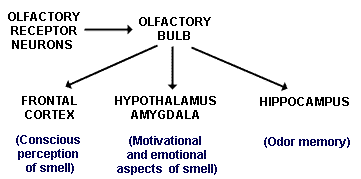
The entorhinal cortex is an important part of this sensory exchange, a gateway for information entering and leaving the hippocampal formation.12

The entorhinal cortex also displays intrinsic memory functions, known as working memory. If one wonders what working memory is? Think of it as a sticky note; it holds new information so the brain can work with it briefly and connect it with other information. That’s where the hippocampus comes to work, the primary purpose of which is to retrieve memories. In the case of working memory, short-term memories are turned into long-term memories and stored elsewhere in the brain.
It is a continuous cycle of storing, redirecting, and retrieving. It allows us to be who we are.
- Expectations can be a critical attribute of flavour. Still, it all depends on what a person expects from an establishment or restaurant: the quality of the food and drinks, the desired level of service, and the excellent time one hopes for.
It is such a tricky part of the flavour to manage, from a business point of view, to make everyone happy, but the last thing a business should do is overpromise and exaggerate. - Cultural background is more applicable for establishments trying to cater to ethnic groups and offering cuisine from different parts of the world or using modified recipes that we might think taste good. Still, it is something these ethnic groups are not familiar with. In cases like that, most people will be disappointed, and their expectations of good food and a great time will not be met.
The Flavour system is the sum of two parts: desire and action.
The first part is all the input received from taste, smell, touch, vision, and hearing, which is used to create the desired flavour image. It forms flavour perception, but that’s only one puzzle part.

Sensory input is essential, but it only creates a sensory image; without activating the sensory action part of the flavour, “I want…” a person will most likely not order anything from the menu or go elsewhere.
In a restaurant environment, a menu is a tool to inform the clientele what the restaurant offers and a chance through images to trigger memories and emotions and increase sales and guests’ experiences.
The second part incorporates and combines the information from all the brain systems responsible for human behaviour; in reality, making sense of all the inputs creates another flavour image called the action flavour image.13 It is an image that prompts us to take action, order, and buy things we like.
Happy guests – Happy bottom line. As a business or even at home while hosting a party, we should know that cooking and making good drinks are only half the guests’ experience. We must activate their sensory action image to make them want what we offer them. Emotions, memories, and desires are feelings triggered subconsciously and used by our consciousness to reinforce the physical attributes of the taste, thus creating a whole multisensory experience. I can put it in just two words, “Happy Guests*.” The ultimate goal of any Food&Bevarage business.
*Think of yourself as a Guest. Treat yourself as such, slow down, and enjoy the world around you!
Footnotes
- https://www.puratos.com/blog/Flavours-more-than-just-taste
- Neurogastrony, Gordon M. Shepard, p.44
- Neurogastrony, Gordon M. Shepard, p.67
- ttps://en.wikipedia.org/wiki/Olfactory_fatigue#cite_note-1
- https://www.researchgate.net/publication/51214009_An_Exploratory_Investigation_of_Coffee_and_Lemon_Scents_and_Odor_Identification
- https://www.bmj.com/content/373/bmj.n1080
- Neurogastrony, Gordon M. Shepard, p.18
- https://www.sciencedirect.com/topics/medicine-and-dentistry/gustatory-system,
- https://www.foodnavigator-usa.com/Article/2010/03/25/Trigeminal-sensations-An-emerging-area-for-innovation?utm_source=copyright&utm_medium=OnSite&utm_campaign=copyright
- Neurogastrony, Gordon M. Shepard, p.129
- https://www.brainfacts.org/thinking-sensing-and-behaving/touch/2020/the-neuroscience-of-touch-and-pain-013020#:~:text=Sensatio
- https://www.sciencedirect.com/topics/psychology/entorhinal-cortex
- Neurogastrony, Gordon M. Shepard, p.157

My brother suggested I might like this website He was totally right This post actually made my day You cannt imagine just how much time I had spent for this information Thanks
Thank you.
I have been browsing online more than three hours today yet I never found any interesting article like yours It is pretty worth enough for me In my view if all website owners and bloggers made good content as you did the internet will be a lot more useful than ever before
Thank you.
Way cool! Some very valid points! I appreciate you writing this article plus
thee rest of the site is extremely good. https://Www.Waste-Ndc.pro/community/profile/tressa79906983/
I do trust all the ideas youve presented in your post They are really convincing and will definitely work Nonetheless the posts are too short for newbies May just you please lengthen them a bit from next time Thank you for the post
I have been surfing online more than 3 hours today yet I never found any interesting article like yours It is pretty worth enough for me In my opinion if all web owners and bloggers made good content as you did the web will be much more useful than ever before